Pages

Sunday, January 31, 2016

New Year in the North

I was hiking Akchour, winding around the mountain, looking ahead at my friend Wade when I realized that it was 2016. New Years’ had come and gone and the thought of resolutions hadn’t even occurred to me.


In recent years few things have occupied more of my time and thoughts. I took a writing class once where the teacher asked us two questions for every story we read: first, what’s happening? And second, what’s really happening? The past few New Years have found me in bed with a mug of coffee and my journal trying to answer those two questions. What happened and what did it mean? 

But this year, I was in a place so physically beautiful I had forgotten to mull. I had forgotten to be resolute! 

We hadn’t looked at a map. We had prepared in no way for what lay ahead and so the hike felt endless. But each turn brought something new. Weave this way and you were in Morocco, that way and it was Japan, here Virginia, there Costa Rica. We looked up to our right and saw monkeys. And down to our left, finally, we saw it: Le Pont de Dieu. The Bridge of God. A stunning natural bridge made from water passing under it. 

So much has happened this year. So much (literal) water under the (literal) bridge. I think of the past year in three parts. The first third, I felt very alone, very aware of it. The second third, I was very social. Nashville in the summertime. The summertime in general. The last third was leaving all I knew, coming to Morocco. 

Last January, when I was working at Trader Joe’s, a woman came through my checkout line who oozed warmth and affirmation. Every now and then I’d get someone who came through my line like her, someone who reminded me what I wanted to be like. We fell into an easy conversation, about Januarys, resolutions, the types of ads you’re pummeled with this time of year. She said something so simple but that pierced me. “Things don’t happen like that,” she said. “Change is incremental.” 

I repeated it to myself in the coming days and months, when it felt like nothing was changing, when it felt like there was no curve in the tracks up ahead for me. Like the little engine that could, I thought of the woman with the warm, shining face. Change is incremental. In the long expanse before spring truly comes, you have to remind yourself again and again. It doesn’t look like things are happening. But they are. Change is coming. It is. 

The early twenties can feel so blind. Every turn feels like it’s the end of the world. You don’t have the rhythm down yet. You want life to happen all-at-once, with a very clear cause and effect. But things don’t happen that way. Instead, you keep going. You refuse to give up. Like the slow relentless course of water, you refuse to look for an easier way around. You follow Mary Oliver's "Instructions for living a life. Pay attention. Be astonished. Tell about it."




Monday, January 11, 2016

Christmas in Morocco

The holidays weren’t nearly as somber as one might expect being 4,000 miles from home. It’s not very hard to ignore when you live in a country that – apart from a few commercial displays aimed at foreigners – doesn’t celebrate Christmas. If a tree falls in the forest, and all that.

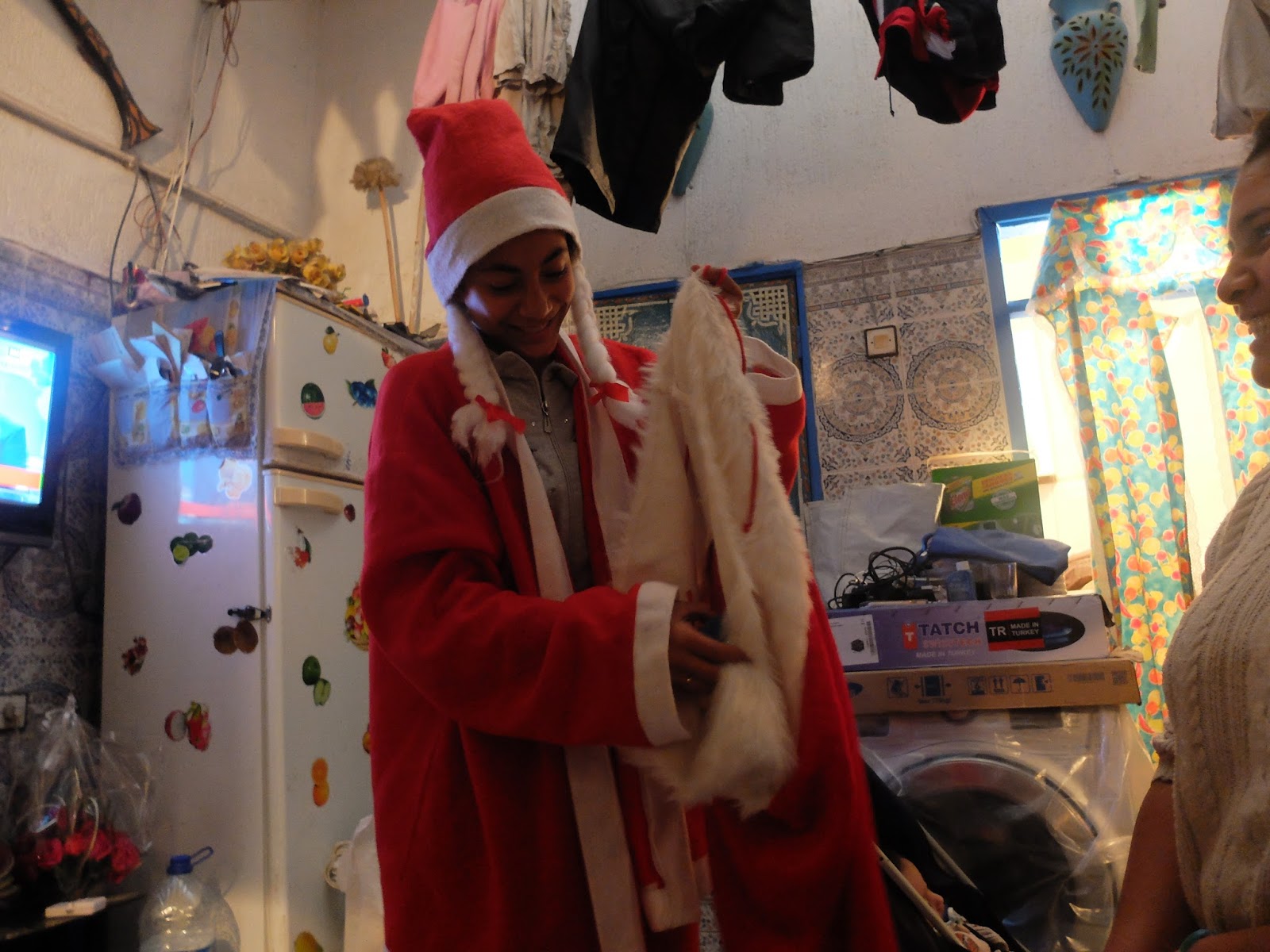
The morning of the 25th, I had Christmas brunch with some other Fulbrighters where I made French toast and nursed a cold. Afterwards – it being Friday – I went to my old host family’s in the medina for couscous. I walked in and Mama Majda told me to close my eyes. When I opened them, 13-year-old Aya was dressed as Santa.


After we ate, three of my host sisters and I crawled into the same bed to take the traditional, post-couscous nap. We kept dissolving into giggles though, reminding each other of times we had mixed up words in the others’ language. There was the time I had been teaching Kawtar an old folk song, "Sweet Betsy from Pike" and she accidentally sang "Have you ever heard tell of sweet Bartus from Pike?" Once Kawtar asked me in Darija when my birthday was. I forgot the word for June – yewnu –and instead said, newnew. And the best, the time when I asked what was for lunch. But instead of lunch, I said the word for poop.


There’s something so funny about mixing up words. This surface-level communication. We couldn't really explain to each other why it was so funny. Except that it just was. It reminded me of laughing with my sisters at home, of laughing so hard that it physically hurts.  


--------- 

When I got back to my apartment, I put on Christmas music. I wanted to try to get in the mood. And besides, I normally love the stuff. The jubilant doowaps of the Drifter’s White Christmas. Bing’s whiny oval-mouthed vibrado.

But my attention wasn’t holding, so I put on Erin Rae’s album, Soon Enough, and played her song “Monticello” through my tiny, tinny speakers. I pressed play while I started doing dishes. Then I pressed it again. And again. And again. The rest of the night.

In it, she talks about the strain of doing what you love, of being where you want to be and yet this homesickness that still seems to permeate everything. Homesickness – not for a place – but for a time. 

"I wish it were Monticello," she sings, "And I could come to see you. And you might talk me down and put my mind at ease. Cause if it were Monticello then I’d be at your table. It might be a while now." And then simply, achingly: "Don’t wait for me."

It was a bright, palmtreesy day in Rabat. I was living the life my eleven-year-old-self described on a bucket list. I wasn’t what you'd call sad, and still, I felt those words in every morsel of my being. It was like I was holding two contradicting things in my lap at the same time.

Taken by Wade Angeli at Rabat Beach on Christmas Eve, 2015


It wasn’t just a Christmas thing either. Even now, sitting alone in the Moroccan equivalent of a Waffle House, I can’t listen to her voice without big, sloppy, toddler tears rolling down my cheeks.

I think that’s the point. 

The holidays typically represent time spent with the ones you love. But it's kinda like speaking different languages with my host family; it's almost irrelevant. It's just a surface measurement of understanding.

Lucky me to have family and friends who I miss every day of the year: Mondays and Thursdays and mornings and afternoons, for concrete reasons like Christmas and not-so-concrete reasons like just because. It’s what makes this whole experience a gift. There’s no escapism here. 

Recently I’ve been struggling a lot. I’ve felt very alone. But behind that is the deeper knowledge that I have these people on my side. And the fact that I’m related to a lot of those people – that I enjoy being around them, that they’re the ones I call to “talk me down and put my mind at ease.” Well, to me that’s the definition of fortunate. That’s all I could ask from this life.


Thursday, December 17, 2015

Little Travels #3

I still owed Nathan the money for my ticket to Milan and the transfer wasn’t going through online (one of the less-romanticized realities of living abroad). So I decided to take the train down to El Jadida for a day trip, to pay him back and to get a little perspective.

Due to university conditions, teaching was getting increasingly stressful and I was exhausted. Exhausted and homesick and blue. Riding the four hour train to El Jadida, I tried to think of nothing.


El Jadida is a very beautiful, sleepy beach town. Two other Fulbrighters were visiting from Agadir, so we did all the tourist attractions and then had a non-traditional Thanksgiving at the McDonalds overlooking the ocean.


We visited the Portuguese Cistern in the medina and drank avocado juice. Everything was cold and bright. 

It wasn't the best day ever, but it was the best day I'd had in a while, and it turned out to be exactly what I needed. Nothing more, nothing less. I rode the train back that night and slept in my own bed and woke up and made myself a pot of coffee and was able to see - and appreciate - that it was a new day. 

--------
I used to think – a little snobbishly, a little naively – that one couldn't get an “authentic cultural experience” without spending a considerable amount of time in a place. That may in some ways be true, but I’ve had a change of heart on the topic. 

Recently I’ve been thinking over what it means to spend just a few days in a place, to have a singular experience there. To be able to look back later in life and think, “Oh, I love Essouira or Milan or middle-of-nowhere-fill-in-the-blank. I love everything about it.” Never mind that you only experienced two days’ worth. You’re not there long enough to be bothered or shocked or annoyed or bored. You get to see only what is truly great about it. And that, I’ve found recently, is a gift. Because we tie whatever is going on in our personal lives' to our outside surroundings, and when we talk about places we’re actually talking about who we were in those places, where we were in our inner lives. 

“We’ll always have Paris,” says Humphrey Bogart in a fedora in the rain. And me in my fleece pajamas in my lonely, little studio, knows what he means. 

Little Travels #2

A friend of a friend contacted me out of the blue saying she’d be on vacation in Rabat for the week. I had been longing to get out a bit so, when we met up and she mentioned leaving for the weekend, I jumped on the opportunity.

Mariah had spent the weekend before at a surf hostel in a town outside Kenitra called Mehdia and had such a good time that she took me back. It was the first time I was traveling without anyone connected to the Fulbright Program and it was liberating to just be a "traveler." I didn't have to answer an amalgamate of questions about my schooling and background and area of study; I didn't have to talk of pHd plans or justify my lack thereof. Moreover, my friend knew nothing of Morocco or any of the languages spoken here so my minimal Darija and horrible French made me come across as an old pro. (To be stressed: come across).


At first it was obvious that the other hostel goers had come there to be alone: Philippe from New Zealand, Sonia from Spain, not to mention me. But Adil, the kook of a guy who was running the hostel, would have none of it and, before we knew it, we were functioning as a unit.

After he took us to his favorite spot on the beach and we were all sufficiently frozen, he took us to a little restaurant on the streets of Kenitra. It was frigid. We sat at a table on the street and dipped hearty chunks of bread into harera, a tomato-based soup with garbanzo beans. It was so cold on the street and I was so hungry that I don't know if I've ever tasted anything so good. None of us talked much as we put away the soup; we were clearly sharing the same sentiments. Afterwards we peeled oranges and drank tea. The whole meal came to 8DH, the equivalent of 80 cents.

After buying loofahs in the medina, we went to the hammam - a public bathhouse - where we parted ways with the boys. It wasn't until we were stripped and basking in the heat that we got to know more about Sonia. At the moment she was a yoga instructor on her way down to Agadir for the winter. She had set up her van as a little bedroom that she could sleep and cook in. She told us how she realized over the years that she can't travel more than six months at a time. After six months, she said, she starts missing her family and home; she misses speaking her own language. It was so nice to be around an older woman for a change, whom I felt was speaking my language.

There was a tangible sisterhood in the hammum: old women and pre-adolescents and very very young boys getting clean and enjoying some conversation while doing it. When Mariah and I got up to leave, two large women came out after us, disturbed that we hadn't washed our hair. They motioned to their own shampoo; they were so concerned. Did we have what we needed?

Back at the hostel that night, Sonia said that she had been planning on driving down the coast the next day but she didn't want to spend her birthday on the road at which point everyone - fifteen or twenty guests now - sang Happy Birthday to Sonia and hugged her like they'd known her for hundreds of years.


We shared some smuggled beer and the stories continued. Phillippe told us how he found himself married and living in Texas at the age of eighteen. (Spoiler: it didn't last long). Sonia talked about her long-term relationship with a man from Israel. They had met in Germany on vacation. He moved to Spain for her, but he didn't speak Spanish and was unhappy. They moved to British Columbia but she missed her family too much and moved back. Finally, after a bout of long distance, they called it quits. Oh, places and all the problems they present! Philippe and Sonia, who had been arguing earlier in the weekend over Catalan independence, realized in conversation that they had been backpacking through Nepal at the same time in the early nineties.


The next day the owner and managers of the hostel decided that in, true hostel generosity, Mariah and I shouldn't pay to take the train back the next day when they could drive us for free. While we said our goodbyes, Sonia realized that in true hostel fashion, she had gotten her days mixed up. Her birthday wasn't until tomorrow.


Saturday, December 12, 2015

Little Travels #1

Hate to say it, I'm a homebody. Wherever I go, I'll find a way to nest. You could drop me in the middle of the forest and I'd arrange the pine needles just so, then refuse to move. (Actually that sounds pretty cozy.) I like the idea of home, knowing that it's there, having a place to call my own.

I guess I'm just a huge fan of the mundane: morning coffee, evening walks, grocery shopping, sleeping in my own bed. I don't need much to make me extraordinarily happy.

But the mundane can get tiresome too, especially when simple tasks take so much effort due to language and cultural barriers. It's important to take a break every now and then. These are some little trips I've taken. I learned something each time I left and was always happy to come back to my precious, pretty mundane joys.

Essouira


At the end of September, three other Fulbrighters and went to Essouira for the weekend. We got there at night and it took us a while of wandering around in the medina to find the hostel where we’d be staying. We finally found what we thought was the place, knocked on the door and asked the guy who answered if it was the “Surf and Lounge Hostel.” He shook his head. We apologized and turned to go when he said, “Are you guys kidding?” He pointed at the sign. “It literally says Surf and Lounge Hostel on the door. Come in.” We walked in where an assortment of travelers were eating Sushi Tajine and Spanish Frittata. It was warm, there was wine, people were talkative, trees grew in the middle of the sitting area. It cost $5 a night. The whole weekend was similarly dreamy.


Milan

In order to maintain my tourist visa, I have to leave the country every ninety days. While we were in Essouira, Nathan and Acacia saw flights online to Milan for fifty euros and they snatched them. But by the time we were set to leave for Milan, I was having financial trouble – my money from my American account wasn’t transferring to my Moroccan account and I had very little actual money to my name. None of us knew any Italian. None of us had any working knowledge of Italian culture. In Morocco people assume I’m French or American, when I’d prefer to practice Darija. In Milan, people assuming I was from there, approached me in Italian. It was odd, having spent so much time studying Morocco's languages, to be dropped in a place where it could get you nowhere. It made the work feel irrelevant, like having the wrong currency in my wallet. 

But it was so wonderful to just walk around. I loved looking at what people were wearing. I gawked at couples kissing in public. It was grey and rainy and I was broke and ignorant but somehow it was absolutely wonderful.


On Saturday we gave in and went to a nice restaurant with heated outdoor seating. Our server happened to be Moroccan. He asked where I live in Morocco. I said, Rabat. He asked where in Rabat. I said, Hassan. He said, where in Hassan. I said, by Place Pietri. And where else would his parents live except in Morocco, in Rabat, in Hassan by Place Pietri? I spoke my minimal Darija to him and later a platter of pizza, bread, prosciutto and olives appeared before us. We looked across the restaurant and he put his hand on his heart, the sign in Moroccan culture for sincerity.

Morocco follows us around and looks after us like a guardian angel. Maybe there's no such thing as having the wrong currency after all. Maybe nothing is irrelevant.

Saturday, November 21, 2015

How it balances out


When my college roommate, Emma, came back from a study abroad trip to Guatemala, one of the first things she told me was how this girl on the trip spent the entire time singing the Patsy Cline song “Crazy” in an elongated, r-less drone. Emma was in a packed elevator of strangers when the voice of her friend, nowhere in sight, pierced the distance.

Cwaaaay-zy. I’m cwazy for feeeeeling this lonely.

I loved the story so much that I took it on as my own, quoting it as if I were there.

In fact, it's my favorite word in Darija: hmk. (pronounced huh-muk), meaning crazy. Wesh nta hmk? You'll hear people ask, are you crazy? It always warrants laughter when I try to use it. Maybe I'm saying it wrong. Or maybe just because it’s a fun word. Huh-muk. It sounds and feels like the situations it describes. You can spit it out like a curse word or a sneeze. And here, it’s a very useful; it comes in handy quite a bit.
 
In the US Culture class I teach, we often talk about the layers of culture. There are the things you see – behaviors and practices – like the tip of an iceberg and then everything else beneath the surface: interpretations, unspoken rules, core values. Down there, you have concepts of things: concepts of self, of beauty, sanity and – my personal favorite – insanity.

I have interactions sometimes where I wonder, very mildly, if I’m insane. Is this normal or am I being pranked? Am I too concerned with being respectful and polite to ask why something this bizarre is happening?

One day I was teaching a class when a student knocked on the door and asked to speak to me. I asked if he was in the class and he said, No, but could he borrow a chair? Yes, quickly, I said in front of my fifty students. The boy walks in and takes an empty chair. Then thirty other students walk in and take every other empty chair in the classroom, lifting them over the heads of my students who sat there with unblinking attention. Was this normal? No one seemed to think twice about it.

Is it normal, that a month into the semester I would have one of my classes taken away from me with no warning and, in its place, an entirely different class of different students at a different time and place, a month behind every other course? Or the fact that I would have a class of fifty students one week, a hundred the next and close to a hundred and fifty after that? I feel like bellowing Patsy Cline myself sometimes.

And yet. And yet.

Recently two Moroccan guys, friends of a friend, helped me find an apartment. I had been at a loss where to begin the process, which can be relentless, aggravating, expensive. But they did all of the heavy lifting. They made appointments. They negotiated for the best price. When I moved, they rented a vehicle and carried all of my stuff up the three flights of stairs. And in return they wouldn’t accept anything other than thanks. No money. Nothing.

The one guy, Outmane, said that helping people makes him happy. “It makes me feel like a real human being,” he said.

My old host sister recently gave me a bag of clothes she had bought for me, choosing things she thought I would like. Thank you, I said, but why? She shrugged. Because I love you.

Or how my host mother took away my right to say thank you. She shook her finger in my face, You are my daughter, she said, you are our family. There’s no more shukran for you, there’s no thank you for family.

They don’t owe me a thing and yet, again and again, I experience the kindness of strangers, of acquaintances, of people who let me in and choose to trust me. Again and again, I feel the warmth of Moroccan hospitality that has no equal, that's nothing less than crazy.

Wednesday, October 28, 2015

What it's been like

In a bizarre turn of events, I found myself in Virginia this week. Now that I’m back in Rabat, drinking mint tea in a cafĂ© by myself, I can’t really wrap my head around the fact that I was taking a walk with my parents the night before last.

Maybe it’s because I brought some flannel back with me but it feels a little like Autumn here too. It’s got me feeling cozy and introspective.

While I was home for a few days, I had the interesting situation of processing out loud something I’m still in the process of doing. It was an exercise in finding out how I feel, hearing myself say things and realizing I meant them. Well, yes it IS going well. Yeah, I guess I DO like it. Now that you ask me, I AM glad I came here.

I think that’s why I’m having a hard time keeping up over here in the blogosphere. It’s not really in my nature to document something in the present. It seems tenuous, considering how moody I can be. And when I go to write, what comes out isn’t what I’m presently experiencing but what I’ve been thinking. Things totally (or seemingly) irrelevant to my surroundings: making French Onion soup in Nashville, my poetry professor in college who began every class by striking a gong, a weird memory I have of crying at October Sky as a kid and not knowing why.

But at the same time I know I should get over that because it’ll be over before I know it, appearing in odd-shaped, amorphous blurs when I go to write about some other future present.

So here’s a taste of what the past two months have been like: